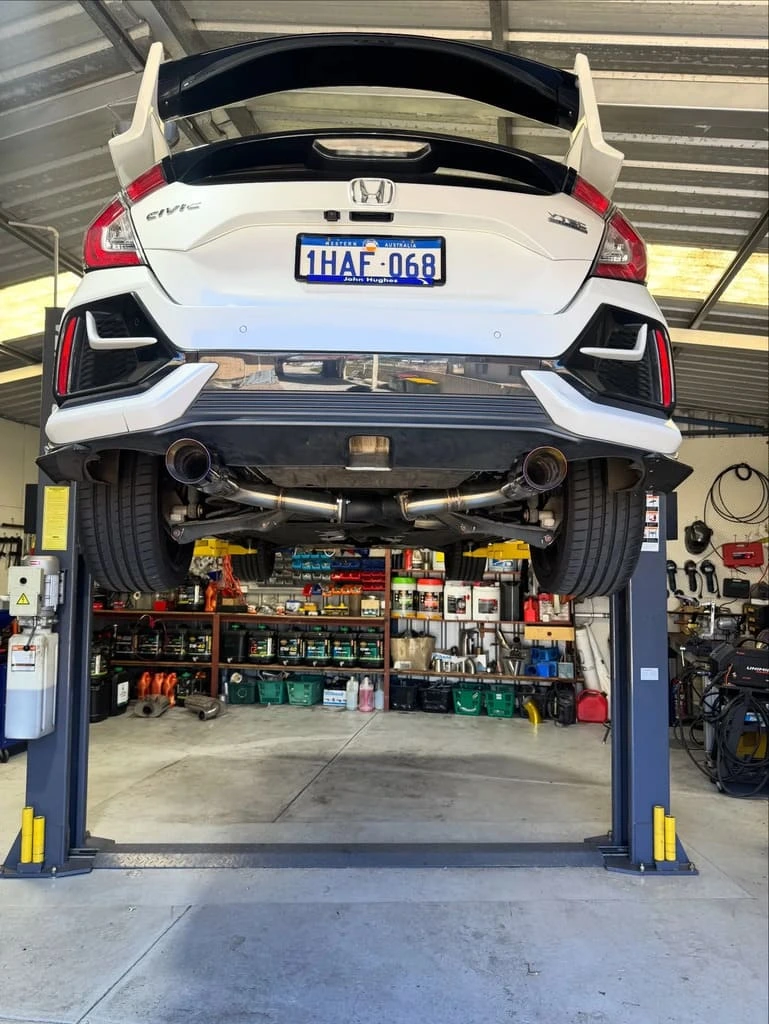
A custom exhaust is built around your car, not pulled off a shelf. That’s the short version. The longer version is that a one-off exhaust system involves measuring, designing, bending, welding, fitting and fine-tuning the sound, and every one of those steps changes how the finished system performs and how long it lasts.
If you’re weighing up custom exhaust systems for a car in Perth, this guide covers what actually happens in the workshop, what drives the price and what to check before you book.
Why drivers choose a custom exhaust over a bolt-on kit
Bolt-on kits work well when your car is close to stock and popular enough for someone to have made one. Plenty of cars don’t fit that description. A custom car exhaust makes sense when:
- No kit exists: Older, rare, imported or engine-swapped cars often have nothing available off the shelf.
- The engine has changed: A bigger turbo, a tune or extra capacity changes how much exhaust flow the car needs.
- The ride height has changed: Lifting or lowering a vehicle shifts the clearances the system has to work within.
- You want a specific sound: A one-off exhaust system lets you choose the note instead of accepting whatever the kit delivers.
- The old system has given up: Cracked, rusted or leaking pipes are a good time to rebuild, and a stainless steel custom exhaust means you shouldn’t be redoing it any time soon.
Step one: consultation and inspection
Every job starts with a conversation about how the car is used (daily driver, weekend cruiser or track car), how you want it to sound and what you’re spending. Then the car goes on the hoist.
We look at the existing system, the space available under the floor, the mounting points, and how close everything sits to fuel lines, brake lines and the driveshaft. We check sensor positions and whether the car is keeping its catalytic converters. The measurements taken here shape every decision that follows. Rush this stage, and you end up with a system that rattles, drones or scrapes the floor on driveways. It’s also why custom exhaust fabrication takes longer than fitting a kit, and why the result is usually better.
Step two: the design decisions that matter
Pipe diameter
Bigger isn’t automatically better. Oversized piping slows exhaust gas velocity, which can cost you low-down torque, particularly on naturally aspirated and small turbo engines. The right diameter depends on engine capacity, power target and boost pressure. A good custom exhaust solution sizes the pipe to the engine, not to whatever looks impressive at the tailpipe.
Layout and routing
Single or dual outlets, where the mid-pipe joins, how the system clears the diff and fuel tank: these choices affect both sound and ground clearance. On a lifted four-wheel drive, keeping the system tucked up and out of harm’s way matters far more than outlet styling.
Mufflers, resonators and catalytic converters
The muffler sets the volume. A resonator targets drone, the low hum at cruising speed that wears you down on a long freeway run. Catalytic converters are emissions equipment, and removing them can leave the car non-compliant, so most builds are better off keeping them and using a high-flow unit.
Exhaust valves
If you want quiet around the suburbs and loud when you choose, electronic exhaust valves let you switch between the two without compromising the rest of the design.
Stainless steel or mild steel?
Mild steel is cheaper and easy to work with, but it rusts, and Perth’s coastal air does it no favours. Aluminised steel lasts longer and sits in the middle on price. Stainless is the long-life option. Grades like 304 resist corrosion well and hold their finish, while 409 costs less and still outlasts mild steel. Titanium is lighter again, but the price and specialist welding put it out of reach for most builds.
For most customers, a stainless steel custom exhaust gives the best balance of lifespan, weight and looks, especially on a car that’s driven regularly rather than stored.
How a one-off exhaust system gets built
This is where custom fabrication separates itself from a muffler swap.
Bending: Mandrel bending keeps the pipe’s internal diameter consistent through a corner. Cheaper crush bending pinches the pipe at the bend and restricts flow, which defeats the purpose of paying for performance exhaust fabrication.
Fit-up: Sections are tacked together on the car or a jig, test-fitted, adjusted, then fully welded. Getting the fit right before the final welds is much easier than cutting a finished system apart.
Welding: Stainless is typically TIG welded. Good workshops purge the inside of the pipe with argon while welding so the inner surface doesn’t oxidise and flake, a defect known as sugaring. It’s invisible from the outside, which is why it’s worth asking about.
Serviceability: Flanges, hangers and slip joints go in where the system may need to come apart later, so the next person under the car isn’t cutting it up.
Fitting and final checks
Once the welding is done, the system is mounted on rubber hangers so engine movement doesn’t crack welds over time. Then we check clearances through the full range of suspension travel, look for leaks and confirm the sensors read properly. A test drive follows, listening for drone and rattles at the revs you actually drive at. A proper custom exhaust installation in Perth finishes with those checks, not at the last weld.
If the engine has been modified alongside the exhaust, a tune afterwards helps the car make use of the extra flow.
Noise and compliance in Western Australia
A custom exhaust still has to meet noise and emissions rules. The Western Australian Department of Transport’s vehicle noise information explains that noise assessments are carried out by Authorised Noise Level Assessors when a vehicle is suspected of being excessively noisy, or when a modified vehicle needs a noise test for licensing.
A reputable fabricator designs for the sound you want while keeping the car on the right side of those rules. Requirements vary by vehicle age and type, so check what applies to your own car before you modify it. This is general information, not legal advice.
What affects cost and timeframe
Pricing varies a lot because no two builds are the same. The main factors are:
- Material (mild steel, aluminised or stainless)
- Pipe diameter and total length
- Complexity, such as extractors, twin turbos or dual outlets
- The number of mufflers, resonators and valves
- Whether catalytic converters are retained or replaced
- The condition of the car and how easy it is to access
Ask for a written quote that spells out the material, the bending method and the welding process. A low price that leaves those details out is rarely the bargain it looks like. Timing follows the same logic: a cat-back system is quicker than a full turbo-back build, and workshop availability often affects the wait as much as the fabrication does.
Questions to ask any workshop before you book
- Are the bends mandrel or crush?
- Which grade of stainless are you using?
- Is it TIG welded, and is the pipe purged?
- Will the finished system meet WA noise and emissions requirements?
- Can I see examples of similar jobs?
Conclusion
A good custom exhaust starts with a careful inspection and measurements taken on your actual car. From there, the design choices matter: pipe diameter matched to the engine, a muffler and resonator combination that suits how you drive, and a material that holds up to Perth’s conditions, with stainless steel the best all-rounder for most builds. The fabrication itself comes down to mandrel bends, clean TIG welds and a fit that’s checked through full suspension travel. Add the Western Australian noise and emissions rules, plus a written quote that spells out what you’re paying for, and you have a system that sounds right, flows well and lasts.
If you’re ready to talk about custom exhaust solutions for your car, contact the Mavs Engineering team with your vehicle’s details and what you want from the sound and performance. We service Perth, including Bibra Lake, Hamilton Hill, Spearwood and surrounding suburbs, and we’ll talk through the options and give you a clear quote before any work starts.
Frequently Asked Questions
1. How much does a custom exhaust cost in Perth?
It depends on the material, pipe size, complexity and how many mufflers or valves you want. A stainless system costs more than mild steel, and a full turbo-back build costs more than a cat-back. The only reliable figure is a written quote after the car has been inspected, so ask for one that lists materials and the welding method.
2. How long does custom exhaust fabrication take?
Simple jobs are quicker than full turbo-back builds, and the work itself is usually measured in days rather than weeks. Workshop availability can add to the wait, so ask for a timeframe when you get your quote.
3. Will a custom exhaust void my warranty or affect registration?
It can complicate warranty claims on parts the exhaust affects, so speak to your dealer first if the car is still under new-car warranty. For registration, the system still has to meet noise and emissions requirements, so check the Department of Transport’s rules for your vehicle before you modify it.